Saturday, 9 December 2017

Marine Diamonds


For thousands of years, diamonds have been swept away by the Orange River to the Atlantic Ocean, only to be picked up by wind-driven ocean currents and deposited on ancient beaches.  Many of these diamonds also ended up on the ocean floor.

Diamonds have a higher specific gravity than most common minerals.  Consequently, they are generally found close to the bedrock and are deposited in high-energy environment sediments containing pebbles, cobbles and boulders.  

It was not until 1954 that the first offshore diamond prospecting started and between 1961 and 1965, a Texan entrepreneur - through the Marine Diamond Corporation (now De Beers Marine) - gave the impetus needed for geological exploration on the continental shelf by exploiting diamonds offshore along the coastline of South West Africa (Namibia today).  This has manifested itself into a growing industry with diamonds being discovered and mined in the nearshore and offshore environments along the coastline from south of the Olifants River in South Africa to some 120km north of Hottentots Bay in Namibia.
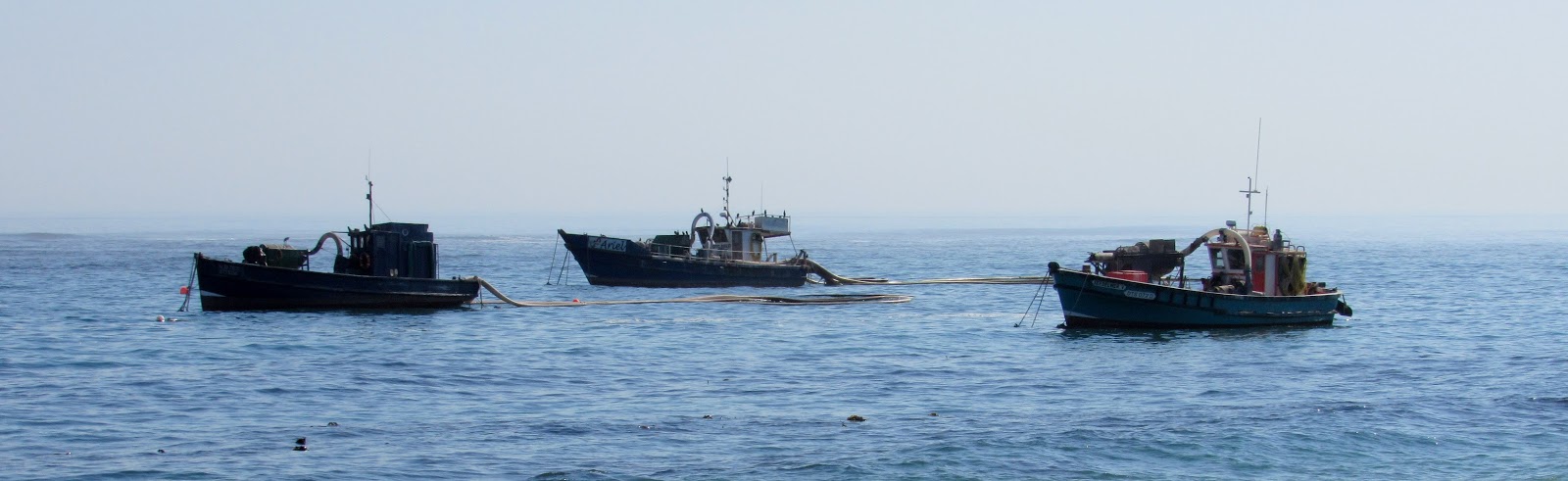

Mining the ocean bed is a daunting task and finding diamonds in this dark, deep world is like searching for a needle in a haystack with your eyes closed.  The first step to mining is to map the mountains and valleys of the ocean floor and the different layers within it.  Offshore diamonds are known to concentrate in gullies, potholes, offshore ridges and ancient submerged bays.  Sophisticated bathymetric (echo-sounding, side scan) sonar and seismic surveys are used to identify these features.  Tiny fossil shells of animals known as foraminifera (informally called forams) provide clues where to search for diamond bearing rocks.  Each sediment layer contains distinctive species of forams, which may be warm- or cold-water species and so convey information about ancient climates and sea levels.


In the shallow inshore zones, to depths of 30m, mining is by diver-operated air-lift dredging.  This entails divers using a suction hose to vacuum up alluvial gravel which is sorted and screened at the surface.  Divers working in gullies close to the shore operate from a shore-based unit, while those in deeper water work from a small vessel.  At depths of 30-80m, most mining is by dredges operated directly from larger vessels.

Deep sea mining, currently limited to waters less than 130m deep, makes use of two techniques.  Vertical mining involves using 7m- diameter drill bits that maintain a force of up to 20 tons.  The mining ships work according to a planned grid, covering the seafloor in overlapping circles to maximise yield.  The other technique, known as horizontal mining, uses a remotely operated vehicle called a crawler.  The crawler advances down specific lanes according to a mapped grid, mining gravel and mechanically transporting it onto a screen.  Oversized material is discarded, and the rest is transported as a slurry via flexible hoses to the ship.  The slurry is then processed on board, being passed through various sorting screens.  The oversize material is returned overboard, while the fluorescent material containing diamonds is separated out automatically, using sophisticated X-ray and robotics equipment, and is then hermetically sealed in cans.  No-one ever sees the diamond treasure in these “Neptune cans” until it arrives at the diamond sorting house back on shore.

In response to concerns that the inshore diamond-mining industry was negatively impacting the West Coast rock lobster fishery, an environmental assessment was conducted by the consulting firm OLRAC.  The study revealed that diver-operated air-lift dredging resulted in only a localised and short-term impact.  The biological community quickly recovered and within a year no difference between mined and unmined sites could be detected.  The consultants nevertheless recommended that the diamond divers should minimise kelp-cutting and avoid revisiting mining sites. 

An environmental impact assessment was also commissioned by De Beers Marine, when the company began mining in 1990.  There were concerns that the ocean floor communities would be irreversibly altered by the disturbance, and that the sediment cast overboard would smother them as it settled.  The study conducted by a team of scientist from the University of Cape Town, revealed that it takes a number of years for the seafloor community to recover.  However, since only a few square kilometers are worked each year, the overall impact is minimal.  The effects of the plume of sediment are limited to a small area around the ship.


Aangenome Eerstelinge: 9 Desember


Lees: Rom 8:23

“En nie net die skepping nie, maar ook ons wat die Gees van God se eerste vrug ontvang het, ook ons sug self in ons binneste, terwyl ons daarna uitsien dat God ons kindskap en die bevryding van ons liggame openlik bekend sal maak.” (DV)

Watter rol die mens in die skepping moet speel, bly ‘n punt van bespreking onder Christene.  Ons vers vandag gee egter heelwat insigte hieroor en roep op tot bekering en vernuwing.

Die eerste vrugte word aan die begin van die oes aan God gewy. Hierdie beeld word gebruik om aan te toon dat die Gees as waarborg, oftewel as deposito, aan ons gegee is (2 Kor 1:22, 5:5). 

As die Gees van God werklik in jou woon, behoort jy aan Christus (Rom 8:9). Die woord “kindskap” verwys na die aanneming as kind met volle wettige regte as erfgenaam. Kinders van God word nou al in hierdie lewe deur die Gees gelei (Rom 8:15), maar hierdie aanneming sal eendag met die wederkoms van Christus vervolmaak word. Ons sug nou al innerlik dat ons aanneming as kind van God en die liggaamlike opstanding openlik bekend mag word. Saam met die skepping sug ons om bevry te word van die bande van die dood.

Dit maak mens nie passief nie, inteendeel, dit maak mens gerig op die lewe. Hoopvol leef die skepping tot lof van die Skepper en hoopvol soek ons die lewe van die skepping - nou al op ‘n klein manier, maar ook tot in ewigheid.

Aangenome kinders wie die Gees as waarborg ontvang het van veel groter dinge wat gaan kom, mag nie daarop uit wees om die skepping te bemeester nie. Met al ons kennis, wetenskap, tegnologie en organisasie in ekonomie en politiek kan ons alte gou die skepping probeer beheer en na ons eie hand sit. Ons leef tans in die middel van ‘n ongekende verlies aan biodiversiteit deur die mens se vergrype aan die lewe van die skepping. Sug ons nog saam met die skepping of is die skepping se versugting ook aan jou en my te wyte?

Aangenome kinders wie die Gees as waarborg ontvang het van veel groter dinge wat gaan kom, mag ook nie wyfelend terugtrek uit die samelewing nie.  Ons hoef nie tot ekstreme maatreels te gaan om die samelewing te verwerp en ons self terug te trek in kerk-ghetto’s, ekologiese kommunes of asketiese lewenstyle of te probeer ontsnap uit ons huidige lewe na die verlede of toekoms. Sug ons daadwerklik nog saam met die skepping, of probeer ons onsself terugtrek uit die skepping?

Aangenome kinders wie die Gees as waarborg ontvang het, leef in volle vertroue en wil meer en meer gevorm word na die Beeld van Christus (Rom 8:29; Kol 3:10).  Elke dag word ons geroep om te deel in die gemeenskap met Christus. Hoopvol dankbaar en jubelend mag ons elke dag lewe en ook lewe vir die skepping bring, ten spyte van ‘n sugtende wêreld vol dood en vernietiging.

Woon die Gees van God werklik in jou? Glo jy in Jesus Christus? Bid vir jouself en vir mekaar dat dit ook mag uitkom in ons denke, houding en optrede in God se skepping.

Sing: SB 20:7,8

Refleksie: Reflekteer oor jou aanneming as kind van God. Reflekteer oor hoe die Gees aan jou gees bekragtig dat jy kind van God is (Rom 8:16). Hoe sug jy saam met die skepping as aangenome kind van God wie alreeds die Gees ontmoet het in jou eie lewe? Bely jou tekortkominge en sonde en bid vir vernuwing in jou verhouding in God se skepping. As jy nie mooi weet waarvoor om te bid nie, rus terug in die hande van jou Vader en laat die Gees wil vir jou intree (Rom 8:26).

Friday, 8 December 2017

Dis nie maklik nie ...


 “My hulp is van die HERE wat hemel en aarde gemaak het.  Die HERE is jou Bewaarder; die HERE is jou skaduwee aan jou regterhand.  Die son sal jou nie steek nie, die maan ook nie by nag nie.  Die HERE sal jou bewaar vir elke onheil; jou siel sal Hy bewaar.”
Ps 121: 1, 5-7

Ons het dit nou net gelees...

Maar dis nog steeds nie maklik nie…

Daar stap hy nou.  Alleen...

Duisend kilometers se sand en rotse en eensaamheid wat voorlê.

Na amper `n hele jaar se voor bereiding en beplanning, het ons nou eindelik by hierdie punt gekom.  Die roete is deeglik beplan.  Ons het toestemming gekry waar ons kon.  Ons het die roete `n paar keer gery.  Fotos geneem van moeilike areas, gevaarlike areas ... probleemareas.  Wonderwerke het gebeur en hekke, huise en harte is vir ons oopgemaak.  Die borge se geld het stuk-stuk ingerol.  Die regte toerusting kon aangekoop word.  Dieëtkundiges het ons gehelp met Jacobus se kos.  Mediese dokters, aptekers en reps het gehelp met pille en verbande vir seer spiere en blase.  Ons het raad gevra waar ons kon...
Maar... Het ons ons geestelik goed genoeg voorberei?


Afgelope Sondag het ons gemeente in Bellville nog vir hom gebid...

Ons het nou net saam op die strand by die Oranjeriviermond eers saam Bybel gelees.  Saam op die nat sand gekniel, terwyl die koue seebries in ons gesigte waai.  Mekaar se hande vasgehou terwyl ons dit doen.

Hoekom staan ons dan nou met trane in ons oë terwyl ons hom agterna kyk?


Trots?  Bekommernis? Twyfel?

Baie vrae.

Gaan hy dit maak?  Is die dertig kilometer per dag nie te veel nie?  Gaan sy lyf dit hou – die swaar rugsak met 10L water, die baie kilometers deur dik sand?  Deur watter diep dale sal hy geestelik moet gaan om klaar te maak?  Die eensaamheid...

Hoe gaan die mense langs die pad vir hom behandel?  Gaan hy verjaag of selfs aangeval word?  Gaan die tracker wat ons by Tracks4Africa gekry het werk?  En die satelietfone?  Het ons genoeg units opgelaai, sodat hy met ons kan praat en ons met hom as dinge te erg raak.

Gaan hy veilig wees teen bruin hiënas, slange, skerpioene en ander ongediertes?
My hart brand in my keel as ek hieraan dink...


Ons ken Jacobus.  Dit is sy droom...  Hy wil iets sinvols doen met sy lewe.  Iets beteken.  Diensbaar wees. 

Ons hoop so dat hierdie opoffering, wat hy met soveel jeugdige entoesiame aangepak het, baie mense se harte sal verander.  Mag dit ander kinders van God inspireer om versigtig met God se skepping om te gaan.  Dit te bewoon, te bewerk en te bewaak...  Mag ons deur ons houding God eer as die Skepper en Onderhouder van alles. 


Ons het op die sand gaan sit en gekyk en gekyk tot hy klein geword het en uiteindelik in die deinserigheid verdwyn.  Sy spore in die begin duidelik sig baar – regtervoet-linkervoet-regtervoet-linkervoet.  Soos hy verder gestap het, het die spore nader aanmekaar gelê tot dit uiteindelik links en regs gestreep het na die horison.


Ek en Henriette en Salomien het mekaar styf vasgehou en weer gebid...

Ons weet waar ons hulp vandaan kom.  Ons het volle vertroue ... in ons Vader.
 “Wees nou maar net stil tot God, my siel, want van Hom is my verwagting!  Sekerlik, Hy is my rots en my heil, my rotsvesting; ek sal nie wankel nie.”
Ps. 62: 6,7


Grote en troue God en Vader,
U wat die hemel en aarde volmaak geskep het deur u Seun,
En wat u Seun aangestel het om hierdie wêreld ook tot sy volmaakte eindbestemming te bring, 
Ons eer U vir die groot wonders en verrassings wat U in hierdie wêreld gelê het. 
Ons erken dat ons nog maar net ‘n baie klein begin gemaak het om hierdie wonders te ontdek en die diepte van u heerlikheid te peil. Ons weet ons is soos kinders wat in die poeletjies speel terwyl die hele oseaan van u grootheid en heerlikheid nog voor ons lê. 
Maar ondanks ons eie kleinheid het U ons tog geroep om daardie grootheid en dieptes te soek en te peil. U het ons selfs aangestel as onderkonings, om as U verteenwoordiger hierdie skepping te regeer en te bring tot sy groot doel: die verheerliking van U Naam. En U lei ons self deur u Woord en Gees om hiervoor ons lewe te gee.  
Daarom dank ons U vir die pragtige inisiatief en geleentheid wat U hier vir Jacobus gee met hierdie staptog. Wil U hom dag vir dag lei, tot ‘n dieper besef van die onvoorstelbare wysheid waarmee U hierdie wêreld gemaak het. Wil u nie net sy voetspore lei nie, maar ook sy hart, dat die verwondering oor mag gaan in ‘n lied. Dat hy sy stem by die groot koor van die skepping sal voeg, om u te eer. 
Ook vir die groot uitdaging en gevare van so ‘n staptog kom ons na U, omdat ons ook hierin u grootheid en trou ken. Wees asseblief met ons seun, ons neef, en gee hom krag en moed op hierdie groot avontuur. Ons weet Here dat hy nooit alleen sal wees op sy pad nie. Ons rus in U sorg en u regterhand wat nooit te kort is om te red nie. 
Ons bid U ook vir die uitkoms van hierdie staptog, dat in dit alles mense weer hulle plek sal leer ken voor u aangesig en hulle taak in u wêreld. Ons groot begeerte en smeking is: Verheerlik tog U Naam deur hierdie kind van u. 
Heerlike God en Vader, hoor ons dank en gebed in die Naam van onse Here Jesus Christus. 
Amen

(Gebed wat Jacobus se oom Jopie gisteraand vir hom gestuur het.)

Land-based diamond mining on the West Coast

Google Earth shows it best. The barren earth. Empty...as if a giant hand took a steel brush and just swept it over the surface of the earth...destroying everything. Plant and bush, quiver trees and lithops... gone! Millions of animals' habitats, where they had lived, found food and shelter, bred... just disappeared!

Diamonds may be a girls best friend, but the process of getting them - especially here in the Northern Cape - is everything but eco-friendly.


Driving past Alexcor and Trans Hex' diamond fields on ground level, you will probably not notice much of the devastation.  A few giant mine dumps, with smaller sand dumps nearby. Gates, fences, warning signs and booms prevent you from going too close. And although towns like Alexander Bay, Kleinzee and Koiingnaas are now more accessible for tourists, it certainly does not mean that you now have free reign to go where you want! The areas surrounding the towns are still restricted. The West Coast of South Africa is the biggest known economic source of alluvial diamonds in the world.  More than 90% of the diamonds recovered are of gem quality, having a colour, clarity and size most desired by consumers in the retail jewellery industry. Strict security is necessary for all diamond-mining operations, as the gems are easy to conceal and steal.


 One can feel almost guilty looking across the fence... I have no desire to go look for diamonds in those mine dumps, but the feeling of thousands of eyes watching you is quite unsettling! Your imagination will take its course... what is happening behind all those "closed doors" in the mining areas?

In 1908 the first diamonds were found at Kolmanskop, near Luderitz (Namibia). Thousands of gold diggers (must we change this expression?) flocked to the area to try their luck. This led to the subsequent discovery of the rich diamond deposits along what is now known as the Namibian coastline.  It was not until 1925 that the first diamond was discovered in Namaqualand on the Port Nolloth Reserve.  Shortly thereafter, concentrated prospecting operations began between the cliffs north of Port Nolloth and the Orange River estuary with only minor activity taking place to the south towards Kleinzee.  In 1926, the rich deposits at Alexander Bay were discovered.  These deposits proved so rich that in 1927 the Government prohibited all further diamond prospecting on state owned land in Namaqualand.  During this time prospecting operations at Kleinzee were laying the foundation for what was to become the De Beers Namaqualand Mines.  In 1928 the South African Government started mining operations at Alexander Bay.  Later diamonds were also discovered and mined elsewhere along the vast coastline.


But where do these diamonds come from?

Diamonds were originally formed at high temperatures and pressures at depths of 150-250 km below the earth`s surface.  These diamonds were brought to the surface by volcanic eruptions.  The resulting geological features are known as diamondiferous kimberlite pipes and are concentrated in the interior of the country.  Over time the top layers of the kimberlite pipes were eroded away and transported by the Orange River and its tributaries to the coast.  Here the soft light material was destroyed and removed by wave action, in the process concentrating the heavier and harder material such as diamonds, on the beach terraces.  In the past the sea level has retreated and advanced several times during global cooling or warming.  At various times, it was as much as 500m lower and 200m higher than it is today.  For this reason diamonds can be found both on land, buried in the sands of the ancient beaches, and underwater, in the sediments of the continental shelf.

Diamond mining concessions cover much of the coastal land between Olifantsrivier in the south and Luderitz in the North, and access is restricted to these areas because of security considerations.  The mining involves removing tons of sand and calcrete, known as overburden, to reach the underlying diamond-bearing gravel.  The overburden, which is up to 35m deep, is removed using draglines, giant scrapers and bulldozers, and is then dumped in areas that have already been worked.  Sometimes the diamond bearing gravel is locked up in concrete-like conglomerates, requiring drilling and blasting.  The remaining bedrock is then cleared and meticulously swept by hand.  Some of the richest concentrations of gems lie in gullies and potholes where the machines cannot reach.

In the recovery plant, the gravel is crushed and scrubbed to remove sand and clay, after which the material is passed through a dense media separation process, where the gravel and diamonds sink out.  Magnetic separation is then used to separate magnetic gravels from the non-magnetic diamonds.  This is followed by X-ray separation to isolate diamonds from the accompanying minerals.  During this process, the diamond fluoresces as it passes under the x-ray beam, and an air-operated ejector deflects it from the main stream of gravel.  The final sorting is done by hand.

It must be recognised that mineral extraction by its very nature has the potential to impact the environment unless carefully managed. The key challenge is Land Disturbance.  Diamond mining uses a variety of methods, some of which involve the removal of large quantities of soil from the earth.  However one must remember that it is economically beneficial to recover the greatest amount of diamonds while moving the least amount of other material. Therefore diamond mines seek to have the minimum sized footprint, and move only that necessary material (known as waste) efficiently. 

To restore the environmental impact of onshore mining the back-dumped overburden is covered with topsoil, which contains the seeds of desert plants.  The seeds germinate and grow to rehabilitate the devastated area.  Whistling rats assist in the rehabilitation process of old dumps by dispersing the seeds in their burrows and fertilizing the plants with their droppings.

Opencast mining is anything but beautiful. There is no denying this fact. Google Earth's satellite pictures tell the true story! But there is - like always - another side of the coin.  Alexcor's territory stretches from Alexander Bay to Port Nolloth. About 90km in length as the crow flies, and kilometers wide as well.  And, contrary to the common opinion, large parts of these areas are intact. It lies before you like a scenic nature reserve, protected against any and all human activities.  Pristine Strandveld Succulent Karoo. This is also thanks to the mining activities taking place further down the road. Here sheep haven't been grazing and trampling everything like on so many neighbouring farms!

Over the years diamond mines have offered work opportunities and jobs to thousands of South Africans - literally food on the tables! A lot has been done in the form of community development projects, empowerment and sustainability in the mining areas.  Infrastructure in the areas has been updated. Also important to remember is the fact that although diamond production in South Africa has dropped from 15 776 000 carats (2005) to 8 450 000 carats (2016), it still is a large contributor to our country's GDP.

Diamonds are forever, but diamond mines are not.  Old worked out mines are filled up and everywhere one can see the signs of Alexcor's rehabilitation programs. We have good hope... even if it is going to take a while!

Beeld van God: 8 Desember


Kol 1:15a: “Hy is die Beeld van die onsienlike God…”
Kol 1:19: “…want dit het die Vader behaag dat in Hom die ganse volheid sou woon”

As daar oor die beeld van God gepraat word dink ons al gou terug na die skeppingsverhaal waar die mens - man en vrou - as beeld van God aangedui word (Gen 1:26, 27).  Die groot denkfout wat mens dan so maklik kan maak is om te dink dat die beeld van God iets is wat eie aan ons menslike natuur is en vandaaruit sekere regte en voorregte aan onsself opeis.  

Hierdie skrifgedeelte vertel ‘n ander verhaal: Jesus Christus is die Beeld van God (vers 15a, sien ook 2 Kor 4:4 en Heb 1:3).  Christus is die een Wie werklik God se karakter reflekteer.  God se volheid is in Hom (vers 19) en is net werklik bekend gemaak deur yy selfopenbaring in sy Seun (Joh 1:18). Net wanneer ons lewens “in Christus” is, wanneer ons onsself met die nuwe mens beklee het, word ons vernuwe na die beeld van ons Skepper (3:10). Enige ander mistiek wat nie deur Christus se openbaring God soek nie moet afgewys word. 

Die onsigbare God kan ons nog nie sien in ons huidige lewens nie. Dit beteken egter nie dat God se geheimenisse so groot is dat ons nie tot Hom kan nader sonder spesiale wyshede, insigte en ‘n asketiese lewe soos wat in die gemeente van Kolosse begin gebeur het nie. Nee! Vir diegene wie aan Christus behoort is God nie meer verborge nie (2:2). Ons mag Jesus sien en Hy is verhewe bo alles (1:18).

Die benoeming van die mens as beeld van God sonder om die verbintenis met Christus te wil aanvaar, doen onnoemlike skade aan God se goeie en pragtige skepping.  Aan die mens word dan sekere goddelike eienskappe toegedig wat weer gebruik word as argument om oor die skepping te heers en dit te onderwerp in ‘n baie bepaalde menslike manier.  Sonder Christus word hierdie heersing en onderwerping niks anders as uitbuiting en verwoesting nie.  Die pad na skeppingsorg loop deur Christus. Hy is die Beeld van God en vir ons om werklik beeld van God te wees soos die Skepper se intensie is, is om Jesus Christus te aanvaar as enigste pad na God toe. 

Sing: Ps 8.

Refleksie: Hoe het jy gedink oor die beeld van God? Kan jy sien hoekom ‘n interpretasie van die mens as beeld van God soveel skade kan berokken aan die goeie skepping? Hoe wil jy leef om werklik Beeld van God te wees?

Daily devotion # 1 and 2

Technology has the tendency to keep humans humble... We are only as good as the technology that works like we planned!  Please excuse us for not posting yesterday's devotion. So for today: a 2-in-1. May this part of our Footsteps-journey also contribute to spiritual growth.


Lewe in die Gees: 7 Desember

Lees: Gal 5:25: “As ons deur die Gees lewe, laat ons ook deur die Gees wandel” (OV)

Op ‘n snikhete dag in die veld kom jy by ‘n koel, skoon waterval of fonteintjie aan. Jy is moeg en het ver gestap.  Sal jy verder stap op jou eie kragte? Sal jy nie eerder van daardie water neem, jou gesig afspoel en daarvan drink nie?  Natuurlik sal jy!

Om die Gees te ontvang hoef jy nie eers ver te stap of moeg te word nie. Die Gees word aan ons gegee uit genade, nie op grond van die nakoming van die wet, maar op grond van geloof (Gal 3:2).  Daarom is dit sulke dwaasheid om nie die geskenk van die Gees te wil ontvang nie en om eerder op eie menslike krag te probeer aangaan (Gal 3:3).  Enige teologie wat nie erken dat die Gees van God aan jou en my gegee word uit die genade van Christus is geen evangelie nie (Gal 1:6-7).  Sulke teologie bring nie die lewe van die Gees voort nie, maar die dood deur ons sondige natuur.

Die woord “lewe” verwys hier spesifiek na die manier hoe om te leef en op te tree.  Jou moraal en karakter word aangespreek.  Om te leef deur die Gees is nie ‘n self-verbeteringsprogram nie, maar is net moontlik as ons bly in die vryheid wat deur Christus se kruis vir ons aangebied word.  Om vry te wees in Christus beteken nie dat dit nie saak maak hoe ons leef nie.  Die manier hoe ons leef deur die Gees word gekenmerk deur mekaar te dien deur liefde (Gal 5:13-14). Jou moraal en karakter word gevorm deur ‘n lewe in die Gees.

Dit is verseker nie maklik nie en is ‘n groot stryd in Christene se lewens (Gal 5:17).  As ons sien hoe God se skepping vernietig word, kan ons gou verval in twis met mekaar, woede oor die sinloosheid, of selfs vyandskap aanwakker en dalk aanblaas tussen gelowiges.  Ook hierdie sondige aard met sy hartstogte en begeertes moet saam met Christus gekruisig word (Gal 5:24).  

Die vrug van die Gees is liefde, blydskap, vrede, geduld, vriendelikheid, goedheid, getrouheid, sagmoedigheid en selfbeheersing (Gal 5:22-23).  Hierdie vrug kenmerk net soveel die lewe van ‘n Christen as natuur en buitelewe liefhebber as enige ander persoon.


Sing: SB 14:2

Refleksie:  Bely jou eie sondige begeertes en hartstogte voor die Here. Bid hartstogtelik vir ‘n lewe deur die Gees.

Thursday, 7 December 2017

Lichen Hill


Just outside Alexander Bay is a small hill - sticking out in orange among the dull greys, browns and whites of the sand and stone in the southern Namib desert. Passers-by will usually just keep on going, not knowing the uniqueness that lies hidden there. To be absolutely honest, there is no place like that anywhere in the whole wide world...


Although the hill seems orange in colour, there are actually no flower-bearing plants on the hill. Every now and then you may see a few conophytums, lithops or other desert plants, but the majority of the hill is covered in a layer of rod-like structures – 10cm thick. Laymen will be excused thinking of these structures as plants, strictly speaking these are neither plants nor animals. These are lichens.  They are symbionts, composed of microscopic algae and fungi. Fungi do not have chlorophyll and do not photosynthesize to produce their own food. A lichen`s fungal part is thus fed by its photosynthesizing algal part. The algal part on the other hand benefits from the association because the fungus are better in finding, soaking up and retaining water and nutrients than they are.  The fungus also provide the resulting lichen shape and the reproductive structures. This type of symbiosis where two organisms live together in synchronised harmony to the benefit of both, is called mutuality. 


What makes the 50ha hillock near Alexander Bay so singular is the diversity and density of the lichen species. As stated by a survey more than 30 different lichen species exist here.


The most probable reason for this is the offshore sea fog. Even though lichens are found mainly in desert-like environments, they cannot live without water. The warm inland at Alexander Bay causes regular strong sea breezes during the daytime, often bringing with it the offshore fog. And this seems to bring the ideal circumstances for lichens to flourish.