Tuesday, 14 November 2017

Even more blessings and miracles

During the first stages of planning, it was a big concern for the Footsteps-team that we have to cross high security and high risk areas where no man has set foot or where no one outside a certain circle, is ever allowed. In a previous post we were so happy to mention Alexcor coming on board and giving permission to cross the diamond fields.

We are once more humbled by the grace of God and the goodwill of man: 

Yesterday, we received written permission for Jacobus and Maricia, who will be his hiking buddy by this time, to hike the coast line cutting through Koeberg Power Plant. 

Today we got an official letter from SAS SALDANHA, confirming the hoped-for permission to walk the coastline of the extensively big area which is part of our National Navy's base of operations around Saldanha Bay. And not only did we get permission, we also got a very personal message endorsing and blessing Jacobus and the Footsteps' enterprise:

SAS SALDANHA applauds your for this tremendous initiative and also recognizes your passion for the environment. We wish you all the best and may the objectives of the walk be attained, in naval terms, allow us to say "Fair wind and following seas!"

We really are on the way with Good Hope!

Project Oystercatcher

The African Black Oystercatcher (Haematopus moquini) is one of the most conspicuous birds of the Western Cape.  Few people know, however, that this iconic bird species was classified as Near Threatened in the International Red Data Book in 2000, because of its restricted range and limited population.  In the early 1980's there were still only about 4800 of them left – the majority on the Islands on the West coast of South Africa (75%) and Namibia (25%).

There are several reasons for their low numbers: African Black Oystercatchers first start breeding when they are older than three or four years and also have only one clutch per year.  Although they lay 2-5 eggs, the annual breeding success is only 0.6 young/pair in protected sites and 0.3 in unprotected sites.  The first-year survival rate is also very low - at 20%. A survey of breeding success carried out in March 1997 yielded alarming results – along some parts of the west coast the number of chicks reared was barely one tenth of that needed to maintain a healthy population. 

African Black Oystercatchers live mainly on filter feeders such as bivalves and limpets and is therefore highly susceptible to harmful algal blooms (“red tides”) which can cause severe local mortality – up to 30-50%.  Avian cholera is also a huge threat.

The African Black Oystercatchers live on both rocky and sandy coasts and to a lesser extent, in estuaries and lagoons.  About 53% of the world’s population can be found on the 1000 kilometre coast between the Olifants River and Mossel Bay.  Of these about 30% are on the offshore islands, mostly in and around Saldanha Bay. Between the Orange River and the Olifants River, oystercatchers are believed to be quite scarce. 


Because Oystercatchers` lives are confined to the coast, they are potentially at risk from all sorts of human factors, ranging from pollution and coastal development, to straightforward disturbance by man, his pets and his toys.  One of the reasons why 4x4s were prohibited to drive on the beaches in 1994, was precisely the plight in which the Oystercatchers were found, and despite the huge public outcry the African Black Oystercatchers' breeding success significantly increased within one year.

An unforeseen fortuitous factor was the introduction of the alien Mediterranean Mussel (Mytilus galloprovincialis) after which island oystercatcher populations increased by 83-156%.  This highly invasive species has taken over our coast at an alarming rate of 115km per year. Since this alien species started to supplant our indigenous mussel, the African Black Oystercatcher adjusted its diet and started feeding on the abundant Mediterranean Mussels.  These alien mussels are also bigger and therefore offer more energy.  It has been reported that the oystercatcher`s reproductive potential has increased following these aliens` establishment.  Good news for our oystercatchers.

Ongoing conservation and monitoring efforts, and the proclamation of marine reserves, have also been of great benefit to this iconic species.  Although the Oystercatchers` numbers have grown to about 6700 birds today, it is still restricted in range and numbers, and potentially vulnerable.


The Oystercatcher Conservation Programme is a multi-organisational project spearheaded by the Percy FitzPatrick institute of African Ornithology at the University of Cape Town.  The aim is to develop a conservation strategy for the oystercatcher and to raise awareness of the conservational needs of Southern Africa`s coast.  Its success, to a large extent, is dependent on public support and participation.

This is why the awareness of the real state of emergency in which this endemic bird species find itself, is so important to us at Footsteps and from the start it was one of Jacobus' chief objects during his eco-walk.  

With the help of Carl Swart, Chairman of A Rocha SA, we came into contact with Dr Mark Brown of the Nature's Valley Trust.  He is very excited about the prospects of working with us and especially to receive important data about the range or distribution and numbers of oystercatchers in the unknown diamond areas north of the Olifants River.  

In the past week Mark Anderson, CEO of Birdlife SA, contacted us and pledged their full support.  To make this oystercatcher-project part of our Footsteps-awareness even more special, is the fact that the African Black Oystercatcher is South Africa's bird of 2018.

Wednesday, 1 November 2017

Mermaids' tears

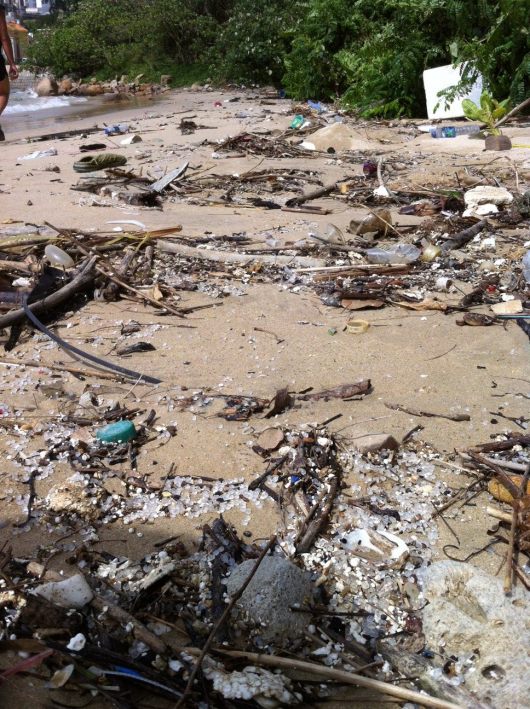
In the midst of a havoc-causing storm in KZN, two container ships collided in the Durban harbour mouth on 10 October 2017 .  At least one damaged container carrying small plastic pellets (nurdles) fell overboard and was allegedly left submerged in the harbour for almost 24 hours.  During the days following the incident, millions of nurdles washed out on Durban's beaches. Sea currents picked up the lightweight nurdles and carried them north as far as Richards Bay, and south as far as the Eastern Cape's coastline.


https://journeytotheplasticocean.files.
wordpress.com/2012/08/spw2kaitak.jpg
Conservation and environmental organisations are calling it “An ecological disaster and an environmental emergency” and have asked volunteers to help clean the beaches.  In the past few weeks, thousands of people ventured to the beaches armed with spades, buckets, nets and containers to begin the painstakingly slow process of ridding our beautiful coastline of nurdles.

Not long ago, most South Africans didn't even know of the existence of nurdles and the enormously dangerous impact they have on nature. We were part of that group not knowing... And when Dr Bob Sluka from the UK contacted us through A Rocha to help with nurdle research on the west coast of South Africa, we had to turn to Google to teach us what we needed to know!  Even with Google-assisted new knowledge, we were unsure if we would be able to recognize the nurdles on the sand of the western coast beaches, and more over, if we would be able to send accurate data concerning nurdles to our Christian eco-friends in the North...

Luckily for us, PlasticSA's John Kieser, a real miracle worker, managed to contact us and it was in his office in Maitland that we had our first real meeting with the "mermaids' tears”, another name for nurdles – small plastic pellets or pipes, all colours and sizes. To tell the truth, we were now even more confused. How on earth will we know which are real nurdles and which are just waste plastics shapen in time by water and sand?  John had an answer for this question too: practice makes perfect!  As we said our good byes, he had a smile on his face and a twinckle in his eye - he handed us a bucket full of plastic pieces. "Go search for your nurdles here. This rubbish was picked up at Yzerfontein."  It worked. We really are getting the hang of it, but we still need more exercise!


John, who has been busy with the cleanup of beaches for a long time now, was very enthusiastic to hear about our project.  A lot of research and work has been done on the Eastern S A Coastline. But on the sparsely populated West Coast, especially in the Northern Cape, data is non-existing. We will be doing groundbreaking work! And obviously this is very exciting to all of us in the Footsteps-team!

But what are nurdles? Where do they come from? And why is it such a problem?

A nurdle is a very small pellet of plastic which serves as raw material in the manufacture of plastic products. During the manufacturing, transport or use of nurdles they are often spilled accidentally into rivers and oceans or fall in drains where they are washed out to sea.  In Europe this is a major problem.  A search of 279 beaches around the UK has found that almost three-quarters (73%) of them were littered with tiny plastic nurdles.  Campaigners estimate that up to 53 billion of these tiny pellets escape into the UK`s environment each year and that 230 000 tonnes enter the ocean in Europe annually.  In 2012, 150 tonnes of nurdles leaked from shipping containers into the sea around Hong Kong and cost the company responsible $US 1,2 million (at that time) to clean it up.


Image result for images of nurdles on beaches
https://www.goodthingsguy.com/environment/nurdles-sa-beaches/
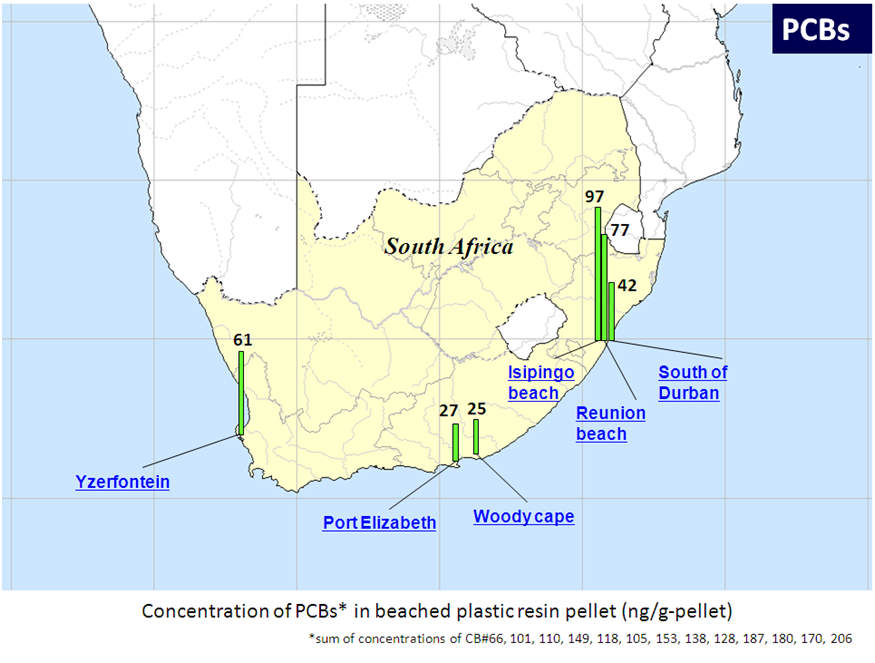
Nurdles are harmful to animals which mistake them for food items.  Not only are they toxic, but they cannot be digested, causing digestive blockages, starvation and death.  In the raw stage (pre-moulded and packaged) new nurdles are not toxic to touch.  Once released into the marine environment they will, over time, attract and concentrate harmful substance and background pollutants like DDT and PCB`s to high toxic levels.  These substances come  from land-based pesticides, herbicides and other organic pollutants that end up in the ocean.  Nurdles never go away, but they break down into smaller and smaller particles that then gets eaten by even more animals and so suddenly are part of people`s food.  

Because nurdles attract toxic substances, they can give scientists a very clear idea of the type of toxins found in the oceans.  Therefore - since there is no data for the northern West Coast of S A - Jacobus, as part of the nurdle project, must search for and collect older nurdles, wrap them in foil to prevent contamination and send it to Dr Hideshige Takada (Laboratory of Organic Geochemistry, Tokyo University of Agriculture and Technology, Fuchu, Tokyo) where it will be used in Dr Takada's Global Pollution research. http://www.pelletwatch.org/ 

 : PCBs concentration of PCBs in beachid plastic resin pellet (ng/g-pellet)

The thing that makes the nurdle problem even more catastrophic, is the fact that nurdles are very, very lightweight and these “mermaids' tears” are carried by the winds and currents of the world, till they are spread around in each and every corner of our planet.  No wonder everybody is concerned. It makes the West Coast and in particular the part of the unpopulated Northern Cape the ideal testing ground. These nurdles would not be locally manufactured and thus will be a very accurate indicator of how far this cancer has spread already...

Find attached Dr Sluka's assignment for Jacobus, for those interested:

It is, of course, possible that there aren't any nurdles in that area. Negative data (not seeing any, while looking for them) would be important scientific information. It does matter where you look on the beach. They are almost exclusively found at the high tide strand line, so that line of algae and debris that accumulates at the high tide mark of the beach. So if you look elsewhere, you don't see any. 

The method is very simple.


1) locate the high tide mark and strand line and identify the location, date, and any other observations that might impact the state of the beach. For example, in some places they regularly clean the beaches, so that would impact how much you see. I doubt that will be the case where Jacobus will be walking! But if there was obviously a very large storm a few days previous, that would be good to note. The FIDRA site asks for "Where did you gather most nurdles? Was it a sandy, rocky or pebbly beach? What were the conditions like? Had there been very high tides, strong winds etc."


2) have a watch/phone to mark the time and start looking, going slowly along the strand line, picking up algae, etc and looking. Sometimes styrofoam balls look like nurdles, so if you squeeze them, you can easily tell if they are plastic or not.


3) search for a pre-determined time. I would suggest 15 minutes as it is long enough, but not too long that it gets dull.


4) Count the nurdles that you see. If it is possible, you can collect them and then take a picture at the end. That can be uploaded and then later we could do some basic looking at whether the type, colour, etc of nurdles changes through the walk. You don't need to keep the nurdles.

You can see the upload page where we will eventually upload and report the data here: https://www.nurdlehunt.org.uk/take-part/share-your-findings.html


Regards

Bob


Fidra, Environmental charity based in East Lothian Scotland
https://www.fidra.org.uk/


Thursday, 26 October 2017

Miracles and mercies

We live in an age where we have so much control over all we do and have, we normally do not see the big and small miracles and mercies in our lives. For us in the drought-stricken Western Cape it is unseasonable to have rain this time of year - but still, we had rain yesterday and today. It is not normal weather to have snow, but we had snow on the Matroos mountains near Ceres last week. These are miracles and mercies from a living God who will not let go of the work He started. These are proof of the hand of the Lord in all things - big and small!

The same phenomenon of miracles and mercies we have learned to appreciate once more since we started with the Footsteps to Good Hope eco-hike. During the last few months we have tried to keep you posted - blogged - about all the happenings concerning Jacobus' walk to Good Hope. Let us share some more good news, indeed, some more miracles and mercies.


We have received generous donations and sponsorships from Ben Groot Attorneys (bengroot.co.za) and Continental Cobbles (www.continentalcobbles.co.za/). These will enable Jacobus to buy the light weight backpack, the super absorbent towel and other much needed gear for his walk. How can we not call these miracles and mercies!


We all know how big an issue the December holidays are - our major time to break away from the everyday rat-race. To have accommodation for this time of year, usually means booking 12 months in advance... We are so very lucky that since our first venue to stay fell through because of serious illness on the proprietor's side, that we were able to secure a place to stay in Dwarskersbos this late in the game - a miracle and mercy! A big thanks to the friendly owners at Sandkasteel in Dwarskersbos!  

We also thank the owners of Seehuisie in Paternoster for being so hospitable and letting us stay in their holiday home. Never-ending, the way the Lord provides. 

We also have been able to secure a venue for our (youth) rally which we are planning for the last weekend before Jacobus finishes. CTEED has generously provided a wonderful back-to-nature camp in Bokbaai, which will suit us perfectly. Interested in the rally? Go check out our Facebook page, or keep an eye out for more info on our blogspot.


We are also now able to share with you the link to the broadcast of Fokus on SABC2 the past Sunday. Is it miracle or mercy - an 18-year old boy on national television, calling upon us all to recommit to caring and conserving the creation God has given us to live and work in? A positive and exciting news bit, among pieces of war, violence, hate, death and destruction! Have a look yourself: https://m.youtube.com/watch?v=cjd9eL0Zsyg

Last, but certainly not least, a miracle and mercy we are still hoping and praying for: in the pipeline is the permission we are hoping to get that Jacobus and - by then -  his hiking partner Maricia, will be allowed to walk the coastline through Koeberg's plant, instead of having to walk the perimeter. This will make a huge difference in the hike, they will not have to scale fences and dodge cars if they can just follow the coastline.


Friday, 13 October 2017

Update... at last!

It has been quiet on the blog this past month. This is however, not a reflection on the amount of work still being done relating to our Footsteps to Good Hope!

Jacobus has been focusing on his matric record exam, with good results. The finishing of school is still part of his life, although I imagine after 12 years he is ready to be rid of it.

Jacobus took a Saturday off to do a "trial-run" on a part of his hike near Melkbos and Koeberg. He was accompanied by his cousin Maricia van der Linden, who will be joining and walking with him on parts of his walk to help with the administration of the project-half of the hike. More on the projects a bit later - especially also exiting news about a new project.


During his hike on Saturday 7 October, Jacobus was interviewed again by Danie Hefers from Focus SABC 2. The interviews and footage taken during the past 2 meetings with Hefers will be aired on SABC in about 3 weeks' time. Danie Hefers is planning to join up with us at the start of the hike, at certain places during the hike and then also be at the end of this walk in Cape Point. The footage and talks he gets from these encounters will be for an episode of Focus in 2018.


Jacobus was very fortunate to be able to "test drive" his new hiking boots on this Saturday, courtesy of A Rocha.  A Rocha has generously sponsored his new shoes as well as donated R 2 500 to be used in the course of this great adventure and endeavour.


Nice new boots, Jacobus...

It looks as if Birdlife SA will be on board for this hike soon.  The Black Oyster Catcher is the SA bird of the year (2018). Jacobus will count sightings, GPS-mark nests and also take pictures of and document information on these facts and other relevant facts e.g. the habitat the birds are using to nest and breed. The information will not only be very helpful in keeping the bird-maps up to date, it will also show the effectiveness of the ban on vehicles on the beaches. The law came to pass when these little creatures were on the brink of extinction.

Our project on the nurdles is still on as well. Look up the nurdles connection in or links on the right-hand side of our blog.  Very interesting and also immensely disturbing!

The nurdles project lead to an exciting meeting. The team met with John Kieser from Plastic SA. This went from a wonderful opportunity to an outright blessing!  Not only has John Kieser personally given Jacobus a GPS to use, he is also using all his knowledge and contacts to get the most amazing support group together. We could not have asked for better - the Lord is truly giving us more than we expected! 

One of the most astounding things to happen, is the fact that Jacobus got permission to walk through the diamond mines between Alexander Bay and Port Nolloth. This was made happen by John Kieser who contacted Ms Leilani Swartbooi, the environmental manager of Alexcor - one of our biggest diamond companies. She managed to get us the coveted permission to walk through these highly restricted and maximum secured fields. Our Lord still makes what we think of as impossible, possible!

John Kieser also gave Jacobus new (fourth) project to add to the to-do-list: he needs to document, take pictures of and GPS-map hot spots of plastic pollution along the West Coast. There is a lot of info on this topic for the more popular parts of our coastline, but this will be a first for the West Coast. Jacobus will put the GPS to very good use!

As a team we are thankful for everyone of these people and companies joining hands to make this eco-awareness hike possible. We are thankful to each and everyone of you following our blog and Facebookpage. We thank you for your support and prayers. Please contact us if you have any questions, if you want to make a donation or have a suggestion.


Wednesday, 13 September 2017

What's in a name?

Quite a lot, where Footsteps to Good Hope is concerned.  Choosing a name for a cause can be as difficult and challenging as choosing your child's name. It has to mean something to you, but also to everyone hearing it. It has to have a deeper meaning - more than just what the eye can see.

In choosing Footsteps to Good Hope, we hoped to achieve just that: to be more meaningful than just a name, a few words stringed together.

Footsteps to Good Hope firstly, asks the attention for the physical journey of 977 km on foot: a gruelling 30 km per day hike, in December's best hot summer weather with the sand of the beach reflecting the brilliance of the sun. A demanding chore for nearly 6 weeks: wake up, pick up your equipment and walk - day in, day out! And just when you think you can get comfortable and in autopilot rhythm, you realize you have to use all your senses to watch, learn, count, observe, take pictures, make mental notes and study. Really see what is around you, the damage done by mining activities, by poaching and looting, by careless people enjoying the beach and ocean waves, but not wanting to take responsibility for it! But also see God's glory shining through in the tiny detail of fauna and flora, making a living and surviving in spite of men's best efforts to destroy everything that is precious and beautiful...


The route will take Jacobus through difficult patches: the diamond mining areas, where no man has stepped foot legally for any other purpose than to mine diamonds. Quite a few National Parks - may they be a testimony to people getting wiser in the areas of conservation and our duty in taking care of nature. He will have to cross rivers, which may be a true blessing seeing how he lives in a province where we have level 5 water restrictions due to a very severe drought. He will also face the obstacle of crossing through the Koeberg Plant. Footsteps to Good Hope - an exhausting trip!


But, and this is where we dig deeper: Footsteps to Good Hope is also a trip aimed at the youth of our nation (and at the human race) - we can make a difference.  We have good hope that if we start today, every tiny bit we do in taking care of creation, will be worth it. We have good hope that we can learn from the mistakes of our fathers, learn from the missteps of our country and the world concerning nature, and do better! It is not too late - do your bit and support those who want to stand up for the environment!

Thirdly, Footsteps to Good Hope symbolises in its name the hope we have that our Lord Jesus Christ is at his Father's right hand - meaning He is ruling the universe. And He will come back and in an instant will change everything so that the whole world will once again be perfect - be as it was supposed to be: glorifying God's great name, his omnipotence and his everlasting love and grace.

And in the Name of this Lord of Lords and King of Kings, Jacobus will start his footsteps-trek. And by the grace and favour of our Saviour, he will be able to finish this trip. And it is in these powerful and almighty hands that we lay this journey, the participants and all of you supporting them! The Lord will perfect that which concerns me: your mercy O Lord, endures forever: forsake not the works of your own hands (Psalm 138: 8)


.

Tuesday, 5 September 2017


Focus on Fokus

The river clean-up which started in March 2017 at the Kuilsriver, is an ongoing project. Although it was started by (youth) members of the congregation of the Free Reformed Church which practically lies on the river banks, this project has the interest of far more than just these few enthusiastic Christians. 

A Rocha South Africa has been visiting the site and are grateful for the efforts. They are organising similar events all over the country (and world). They did a beach clean up at Blouberg and Strand beaches these past two Saturdays.  A meeting on river clean up issues will be held on Thursday 7 September at 19:00 in the Free Reformed Church of Cape Town (corner of Frans Conradie and Stellenbergweg, Bellville). Details on this: https://www.facebook.com/A-Rocha-South_africa-1762121324145733/
For more info on A Rocha, follow them on their own website: www.arocha.org.za  

Fokus - the Afrikaans current affair TV program on SABC 2 - has also heard of these efforts and was on site to see what is actually going on.  The state the rivers are in, especially in the Western Cape, is a big concern to environmentalists, but it should be a concern to all of us. The Nederdutch Reformed Church La Rochelle took their turn in cleaning up, and were part of the footage shot to use in the Fokus program.  The program aired this past weekend. See for yourself: https://youtu.be/s25ti7BPJC4

Kuils River residents have complained about the filthy state of the area’s main river. Picture: Giovanna Gerbi/Eyewitness News